Why Translation Apps Fail at Teaching Tonal Languages
August 24, 2026 · 8 min read · Published by Tolk

Your translation app shows the correct Vietnamese word on screen. You say it out loud. The street vendor stares back, confused, or worse, offended. The problem? Thai has five tones where the same syllable, "suay," means either "beautiful" or "bad luck" depending on pitch. Standard romanization systems can't communicate that difference, and your eyes reading text will never teach your mouth the right sound.
The screen looks right but your mouth gets it wrong
You're standing at a Bangkok market, phone in hand, ready to compliment a vendor's silk scarves. The app shows "suay" for beautiful. You say it with confidence. The vendor's face falls. You've just told her that her products bring bad luck.
The design flaw is fundamental. Text-based translation interfaces were built for written languages, where spelling maps to meaning. Tonal languages break that assumption entirely. The same romanized spelling carries completely different meanings depending on pitch, and no amount of on-screen text can teach your voice the difference.
Thai's five tones create invisible minefields. "Suay" with a rising tone means beautiful. "Suay" with a falling tone means bad luck. Your eyes see identical letters. Your mouth has no guidance. The vendor hears something you never intended.
Romanization systems were never designed for this. They capture sounds, not tones. What works for Spanish or French falls apart when pitch determines whether you're being polite or accidentally insulting someone's grandmother.
The 2026 accuracy gap hits hardest here. Mid-resource language pairs like Vietnamese and Thai carry more variance in accuracy than high-resource pairs like English-Spanish. When you add tonal complexity to that gap, the margin for error multiplies.
The result? Your translation looks perfect on screen while your pronunciation creates the opposite meaning.
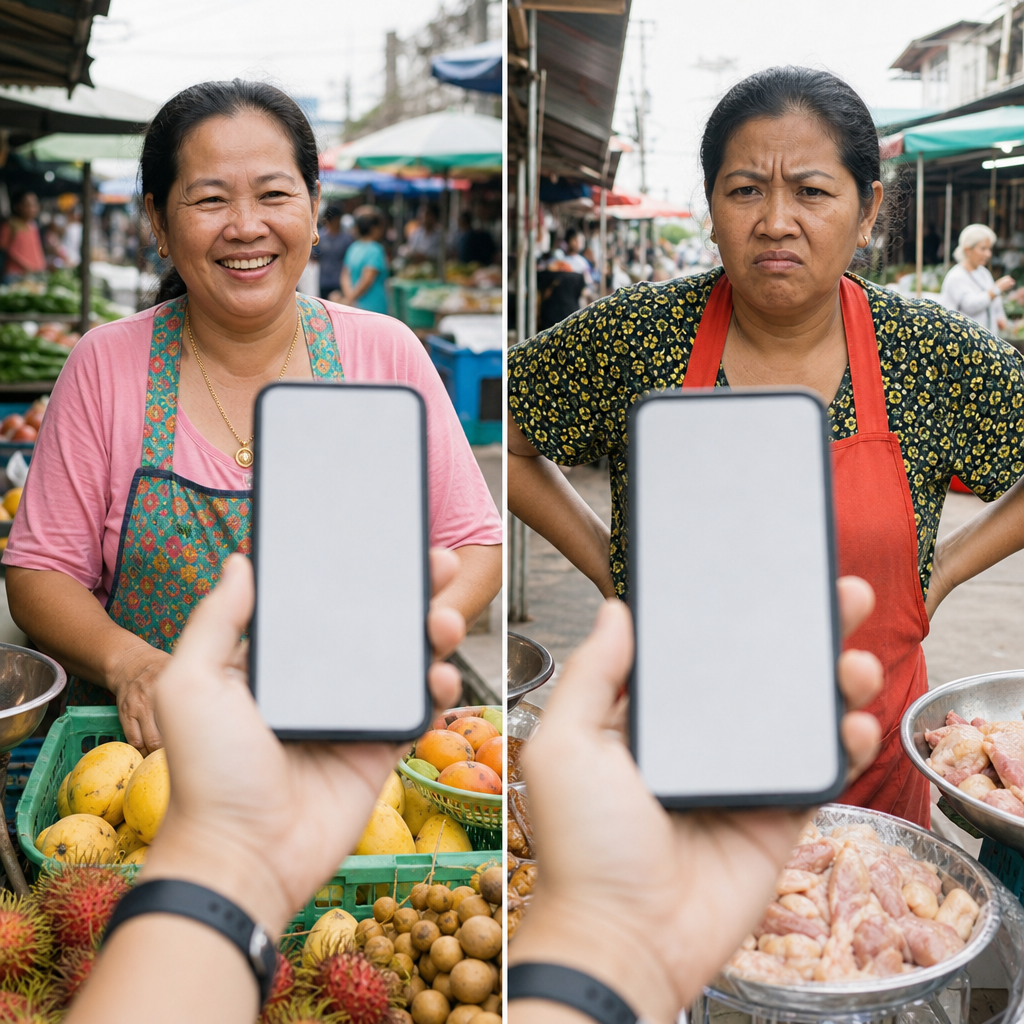
Scenario one: Asking for directions and ending up lost
You're standing on a busy corner in Ho Chi Minh City. The restaurant should be close. Your phone shows the Vietnamese word "gần" for "near," and you ask a passing local for help. She looks at you strangely, says something back, points down a long street. You walk twenty minutes in humid heat before realizing you're nowhere near your destination.
The problem? Vietnamese has six tones, and the difference between "gần" (near) and "gân" (tendon) comes down to pitch contours your eyes never saw on screen. You asked about proximity. She heard something about tendons. The confusion was inevitable from the moment you read romanized text without hearing how it should actually sound.
This scenario plays out constantly across Vietnam. Travelers reading diacritics they can't interpret. Locals doing their best to understand sounds that don't match any word they know. Both parties walk away frustrated.
Turn-based conversation modes add another layer of friction. They require alternating turns with no true simultaneous translation, and Vietnamese voice output often sounds robotic. Accuracy drops noticeably with fast or accented speech, which describes nearly every street interaction in a busy Vietnamese city. A Vietnamese voice translator that captures tones bridges that gap by letting locals hear the actual tonal pronunciation, not a flat robotic approximation.
The twenty minutes you lost were the cheap lesson. The real cost is the connection that never happened.

Scenario two: Market negotiations that accidentally offend
Chatuchak Market in Bangkok. Thousands of stalls, weekend crowds, and you've found a vendor selling handwoven textiles that would be perfect as gifts. The price seems high. Building rapport first makes sense.
You pull up your translation app, find the word for beautiful, and say "suay" to compliment her work. Her expression shifts from friendly to guarded. The sale is already lost.
Here's what happened. Thai has five tones, and "suay" with a rising tone means beautiful. With a falling tone, it means bad luck or unlucky. Your flat American pronunciation landed somewhere in between, closer to an insult than a compliment. You essentially told her that her craftsmanship brings misfortune.
Reading romanized text cannot teach you pitch. Your eyes see letters. Your brain processes them as English sounds. Your mouth produces toneless approximations that Thai speakers struggle to decode. The vendor isn't being difficult. She genuinely cannot understand what you meant.
The accuracy gap matters here. Voice models optimized for tonal languages deliver noticeably more accurate results than general text translators, specifically because they capture the tonal nuances that text alone misses. A Thai voice translator for real conversations lets the vendor hear the actual tonal pattern, not your best guess at pronunciation.
That textile vendor wanted to sell to you. The communication barrier stopped a transaction both parties wanted. The technology existed to bridge it.
Scenario three: Medical situations where tone changes everything
You're sitting in a Hanoi clinic, stomach cramping, trying to explain your symptoms to a doctor who speaks limited English. Your phone becomes your lifeline. But Vietnamese medical vocabulary shares syllables across completely different meanings, and tones determine whether you're describing mild nausea or something far more alarming.
Step 1: The tonal minefield activates. You attempt to describe pain location and intensity. Vietnamese words for body parts, symptoms, and severity often differ by a single tone. Your flat pronunciation turns a description of stomach discomfort into something the doctor interprets as a different organ entirely. She orders tests you don't need.
Step 2: Stress compounds the problem. Accuracy drops in four predictable situations: heavy accents, very fast speech, technical jargon, and background noise. Medical settings trigger multiple factors simultaneously. You're anxious, speaking faster than normal. The clinic buzzes with activity. Your voice wavers. The translation quality deteriorates exactly when precision matters most.
Step 3: Real-time confirmation becomes critical. Reading text off a screen won't help when the doctor needs to hear symptoms described accurately. You need to hear correct tones, attempt them yourself, and watch the doctor's face for confirmation. Text-based apps turn a two-way conversation into a frustrating game of telephone.
The market vendor scenario cost you a silk scarf. Medical miscommunication carries different stakes entirely.
Why text interfaces will never solve tonal languages
The mismatch runs deeper than app design. Text-based translation assumes a fundamental skill that doesn't transfer to tonal languages: the ability to produce sounds from reading. English speakers learn this works. See a word, say the word. Spanish, French, German follow roughly the same pattern. Vietnamese and Thai break the pattern entirely.
Romanization systems were built for native speakers who already carry tonal maps in their heads, not for travelers producing sounds from scratch.
Vietnamese Quốc ngữ uses diacritics that look decorative to untrained eyes. Thai romanization strips away tonal markers entirely. Both systems assume the reader already knows what pitch pattern belongs to each syllable. A native speaker sees "gần" and automatically applies the correct falling-rising tone. A traveler sees letters and produces flat sounds that don't register as words.
Regional dialects compound the problem. Strong regional accents, from Southern Vietnamese to Isaan Thai, reduce translation accuracy significantly compared to standard accents. The phrase you practiced in your hotel room collides with the actual speech patterns of the person standing in front of you. Even accurate translations fail when real speakers don't sound like training data.
Then there's the reliability ceiling. According to testing of the best translator apps for travel, system failure occurred at 86 seconds in some apps during long-form sessions. The tool stops working exactly when conversations move past simple phrases into actual communication.
Text got you into this problem. Only audio gets you out.
Voice-first translation: Hearing tones before speaking them
The fix is surprisingly simple. Instead of reading romanized text and guessing at pitch, you hear the exact tonal pattern first. Then you repeat what you heard to the person standing in front of you.
This creates a feedback loop that text can never provide. When your ears receive correct tones, your brain starts mapping pitch patterns to meaning. Your mouth produces something closer to comprehensible because you're mimicking actual sounds, not interpreting letters through an English filter. The Vietnamese vendor hears a recognizable word. The Thai doctor understands your symptoms. Communication happens.
The situations where this matters most are exactly the ones travelers face constantly. Ordering street food in Bangkok where vendors speak fast and loud. Meeting Vietnamese in-laws for the first time when impressions count. Sitting in a Thai hospital explaining symptoms while anxiety makes your voice waver. These are face-to-face moments where reading a screen means breaking eye contact, losing connection, and often mangling the very word you needed to say correctly.
A voice translator that carries meaning and tone bridges what text cannot. You hear the rising tone on "suay" that means beautiful. You produce something close enough. The vendor smiles instead of frowning.
The 2026 accuracy problem isn't about building better romanization algorithms. It's about abandoning the assumption that screens can teach mouths. They can't. Ears teach mouths. Always have.
Try Tolk's Thai voice translator free and hear the difference tones make in your next real conversation.
Tolk is a Voicelabs app for face-to-face conversations. Read how Tolk works for the conversation flow, supported devices and getting started, or see what changes in Tagalog, Spanish, French, Portuguese, Japanese, Korean, Mandarin, Arabic, Thai, Vietnamese, Slovak.

Try real-time voice translation.
Start with 30 free minutes on iPhone or Android.