Vietnamese Market Bargaining: When Free Apps Cost You More
July 27, 2026 · 8 min read

You type "how much?" into your translation app, hold up your phone to the vendor, and watch her face shift from friendly to firm. The price doubles. Vietnamese has six tones, and the difference between a polite question and a demand can come down to a single rising or falling pitch. Free translation apps get the words right. They miss the music that determines whether you pay the local price or the tourist tax.
The hidden price of tone-deaf translation
Step 1: The words come out right, but everything else goes wrong.
You press play on Google Translate's audio for "bao nhiêu tiền" and the vendor's expression shifts. The price she quotes is triple what the local beside you just paid. Your pronunciation flagged you before you finished the sentence.
Step 2: Six tones carry more than meaning.
Vietnamese tones do more than distinguish between "mother" and "ghost" (both spelled "ma"). They communicate respect, familiarity, and social positioning. Vendors read these signals instantly, the same way English speakers pick up on someone's confidence or hesitation. A flat, robotic delivery from a translation app broadcasts "outsider who won't know better."
Step 3: The dictionary definition is only half the conversation.
Free apps translate text perfectly. They strip away the social signals that determine whether you're treated as a guest or a mark. The technical accuracy is impressive. The cultural accuracy is missing entirely.
Step 4: The costs add up, sometimes in money, sometimes in closed doors.
Overpaying 50 to 200 percent on fruit, coffee, and souvenirs hits the wallet hard over a two-week trip. The bigger problem comes when tone-deaf pronunciation sounds rude or aggressive. Some vendors simply walk away. Others quote a price designed to make you leave. The negotiation ends before it starts.
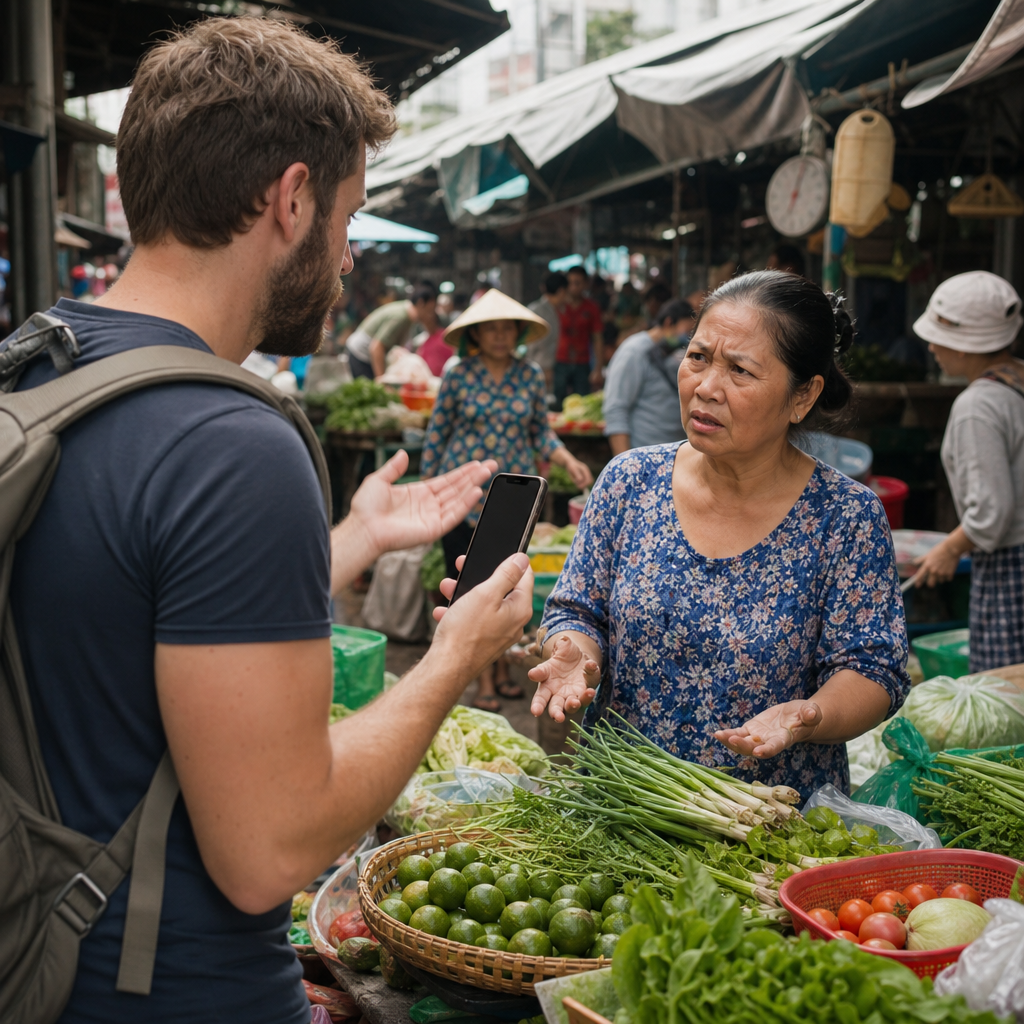
What actually breaks when apps translate Vietnamese
The technical limitations run deeper than most travelers realize. SayHi Translate, ranked among the best translation apps by GadgetStripe, doesn't even support Vietnamese for its Conversation feature. Users get basic speech recognition and text-to-speech, nothing more. For a language spoken by nearly 100 million people, that's a significant gap.
The 44-week estimate for learning Vietnamese exists for a reason. Tones aren't decorative flourishes added on top of words. They're structural. Apps that flatten or mispronounce them produce output that's technically correct but socially broken. A Vietnamese voice translator needs to capture these distinctions, or the translation fails before the meaning lands.
Regional dialects make things worse. Northern and Southern Vietnamese differ enough that an app trained primarily on Hanoi speech may struggle with Saigon vendors. Add market noise, competing conversations, and street traffic, and accuracy drops further.
Then there's the rhythm problem. Most translation apps, including Google Translate, operate in turn-based mode. Speak. Wait. Listen to robotic output. The vendor responds. You wait again. Haggling thrives on quick exchanges, playful counters, and reading reactions in real time. Turn-based translation kills that energy completely. By the time your translated offer plays, the moment has passed. The vendor has already mentally sorted you into the "difficult tourist" category, and the price reflects it.
Three market scenarios where literal translation fails
The words your app produces are technically accurate. The problem is that market interactions in Vietnam are social dances where tone carries as much information as vocabulary.
Asking about ingredients at a phở stall. "Có đậu phộng không?" means "does this have peanuts?" But delivered with a flat, robotic tone, it sounds like an accusation rather than a polite health inquiry. The cook hears a demand, not a question. The dismissive wave you get back isn't rudeness. It's a response to what sounded like rudeness from you. For someone with a serious allergy, that miscommunication carries real risk.
Declining a vendor's offer. "Không cần" translates to "no need" or "no thanks." Vietnamese speakers soften this phrase with an apologetic, almost regretful tone. Without that softness, you sound angry or disgusted by what they're selling. Vendors often look genuinely hurt. Some stop engaging entirely, assuming you have a problem with them personally.
Negotiating on price. "Đắt quá" means "too expensive." Said with a playful, rising tone and a smile in the voice, it's an invitation to banter. Said flat, it's an insult to the vendor's pricing and, by extension, their judgment. One version starts a fun haggle that both parties enjoy. The other creates an awkward standoff where everyone wants the interaction to end.
The dictionary got every word right. The social context never made it through.
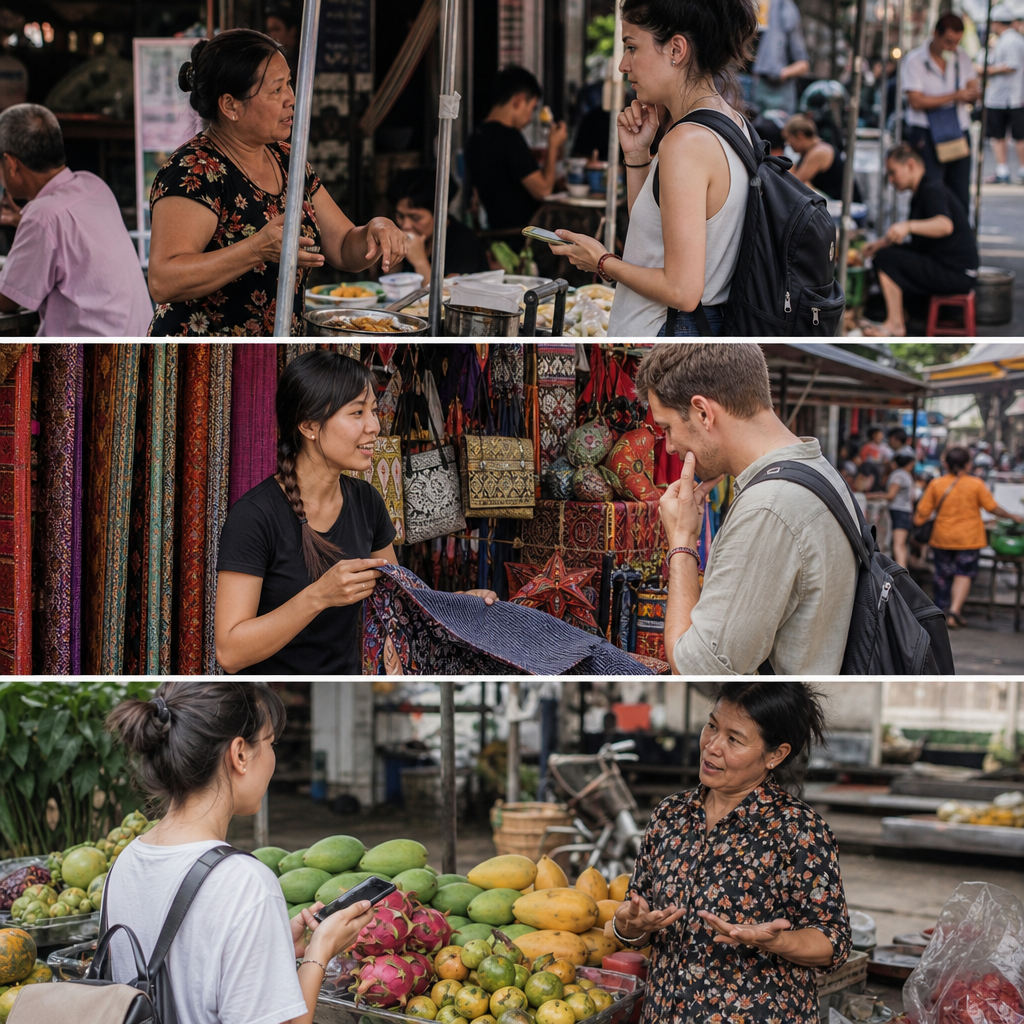
Why even good apps struggle with Vietnamese market chaos
The gap between demo conditions and real-world performance becomes obvious the moment you step into a Vietnamese market.
Background noise destroys accuracy. Motorbikes weaving through crowds, vendors shouting prices, music blaring from competing stalls. Strong regional dialects and background noise significantly reduce translation accuracy, and Vietnamese markets deliver both simultaneously. The clean, quiet recordings used to train these apps bear no resemblance to Bến Thành at 10 AM.
The real bottleneck is conversation flow, not speech recognition. A recent comparison of real-time translation apps points to the core technical challenge: handling two speakers simultaneously, auto-detecting languages, managing turn-taking, and delivering low-latency playback without manual button taps. Speech-to-text has improved dramatically. The rapid back-and-forth of haggling still breaks most systems.
Apps insist they're right when native speakers disagree. iTranslate users fluent in five or more languages, including native speakers, have reported translations marked as correct that locals immediately recognize as wrong. The company's response: the app is right. That confidence gap creates real problems when you're relying on the output for a price negotiation.
These tools were built for a different use case entirely. Most translation apps excel at reading menus, decoding signs, or composing text messages. The fast, emotionally charged, face-to-face exchanges that define Vietnamese market culture sit far outside their design parameters.
The apps work beautifully in hotel lobbies. Markets are a different story.
What actually works for Vietnamese market conversations
The shift isn't about finding a better dictionary. It's about translation that captures what you actually mean, not just the words you'd use to say it.
Vietnamese vendors respond to tone, rhythm, and social signals within the first few syllables. A voice translator app that translates what you mean rather than your literal words changes the entire interaction. Polite inquiry sounds polite. Friendly negotiation carries warmth. Genuine appreciation lands as genuine. The output sounds human because it preserves the intent behind what you're saying.
Hands-free operation matters more than most travelers expect. Markets involve pointing, holding produce, exchanging cash, and dodging motorbikes. The turn-based tap-speak-wait model falls apart when both hands are occupied. Users on Reddit have been asking about hands-free, real-time voice translation for exactly this reason. The technology exists. Most apps just haven't caught up to how people actually use them.
The goal here isn't replacing the 44 weeks needed to properly learn Vietnamese. That's a different journey entirely. Real-time translation bridges the gap so your interactions feel natural to the person standing in front of you. Vendors recognize the difference between a tourist reading robotic output and someone communicating with genuine respect.
The result? Better prices, yes. But also conversations that turn into recommendations, directions to hidden lunch spots, and the kind of interactions that make travel memorable.
Beyond the market: Where tone-aware translation pays off in Vietnam
The market vendor is just the most visible example. The same tone dynamics shape every Vietnamese interaction you'll have.
Ordering phở with the wrong tonal inflection gets you a confused look or the wrong dish entirely. Asking a taxi driver for directions with flat, robotic pronunciation often results in a longer route, whether intentional or because he genuinely misunderstood. Meeting your partner's Vietnamese parents for the first time? The stakes jump considerably higher than overpaying for mangoes.
Vietnamese is one of the most used languages on the internet despite its difficulty, driven largely by global fascination with phở, bánh mì, and the country's food culture. That growing interest means more travelers, more expats, and more cross-cultural relationships running into these exact communication barriers.
Expats and couples in Vietnamese-English relationships feel the gap most acutely. Vocabulary apps build word lists. They don't teach the subtle tonal shifts that separate a respectful request from an accidental insult at a family dinner. Years of immersion eventually solve this. The best voice translator app bridges that gap while the learning happens, capturing what you actually mean rather than producing technically correct but socially broken output.
Every conversation is an opportunity. A chat with a cyclo driver can turn into local restaurant recommendations. A warm exchange with a shopkeeper becomes a genuine connection. Or it stays transactional because the tone never landed right.
Try Tolk free for your next Vietnamese market visit and hear the difference tone-aware translation makes.