Voice Translator App for Local Service Providers
October 12, 2026 · 8 min read · Published by Tolk
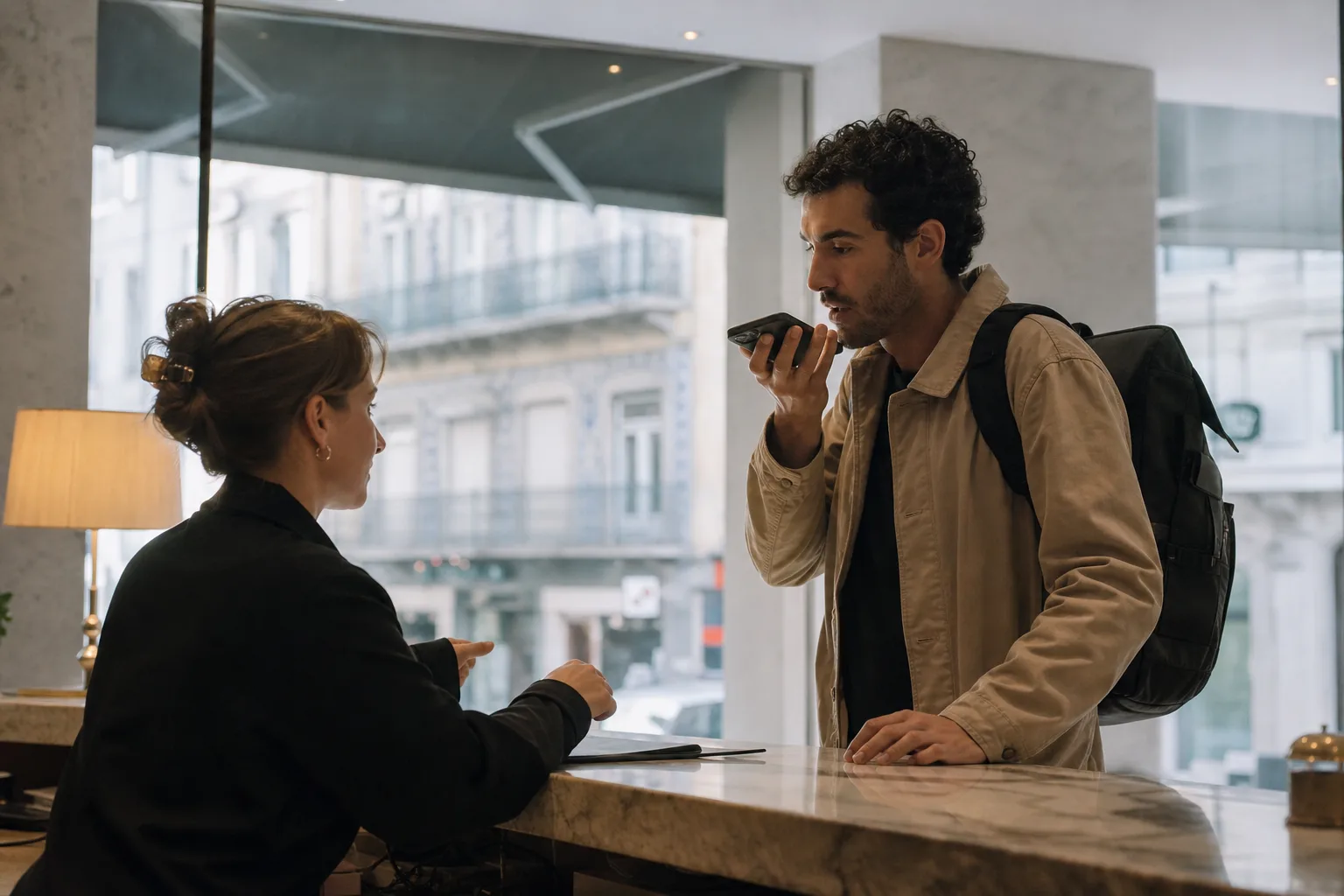
Hiring a local plumber in Madrid or scheduling movers in Tokyo sounds straightforward until the conversation starts. Professional service providers report that 68% of miscommunications with international clients come not from vocabulary gaps, but from misunderstood tone and context. A contractor explaining safety protocols or an electrician walking through an estimate requires nuanced back-and-forth, often 12 to 15 conversational turns, far beyond what any phrasebook app can handle. For expats and international families relying on local services, a voice translator app that captures meaning and tone makes the difference between a smooth home repair and a costly misunderstanding.
Why local service conversations need more than phrasebooks
Ordering coffee takes two exchanges. Coordinating with movers takes twelve to fifteen. That gap explains why so many expats and international families find themselves stuck when local services get involved.
The scenarios are familiar. A visiting son-in-law trying to coordinate Portuguese-speaking movers while his partner handles work calls. An expat couple meeting their building's Romanian maintenance team for the first time, unsure how to explain that the heating hasn't worked properly since November. A small business owner helping a tourist client arrange emergency pet care before an unexpected flight home.
Each situation demands real conversation. Back-and-forth negotiation about timing. Technical questions about equipment or procedures. Scheduling adjustments when something changes. Phrasebooks simply cannot anticipate these exchanges. They offer fixed sentences for predictable moments, not the flexibility that service discussions require.
The deeper problem goes beyond vocabulary. Professional service providers report that 68% of miscommunications with international clients stem from misunderstood tone and context, not missing words. When a plumber explains that low water pressure is completely normal for an older building and nothing to worry about, that reassurance matters. Word-for-word translation often strips away the nuance, leaving clients uncertain whether they have a serious problem or a minor quirk.
Service conversations need a voice translator app that captures meaning alongside technical accuracy. The difference shapes whether a home repair ends smoothly or spirals into confusion.

Extended conversations: Repair estimates, scheduling, and negotiations
Service conversations follow a different pattern than tourist exchanges. A home repair estimate alone involves multiple discussion threads happening simultaneously.
- Material options and trade-offs: A contractor in Warsaw explaining why ceramic tiles cost less but porcelain lasts longer in high-moisture bathrooms. That comparison requires back-and-forth clarification, not a single translated sentence.
- Labor costs and timeline questions: Understanding whether "three days" means consecutive workdays or spread across two weeks. Knowing if the quoted price includes cleanup or ends when installation finishes.
- Access arrangements and scheduling: Coordinating key handoffs, agreeing on start times, discussing which rooms need to stay accessible. A furniture delivery team in Lisbon might need to know about narrow stairwells or parking restrictions before arrival day.
- Technical troubleshooting: Explaining to a technician in São Paulo that the washing machine makes a grinding noise only during the spin cycle, but only when fully loaded. That level of detail matters for accurate diagnosis.
The mechanics of conversation create their own friction. Typing into a text translator interrupts the exchange every 8 to 12 seconds, breaking rapport and stretching a 15-minute discussion to 35 minutes or more. Both parties lose the natural rhythm that builds trust.
A voice translator app that translates what you mean keeps the conversation moving. The contractor stays engaged, the client stays informed, and the estimate discussion actually finishes before lunch.
Hands-free operation when people are working
A mechanic diagnosing an engine problem cannot stop to type every sentence. Neither can the electrician checking a fuse box, the moving crew lifting a sofa through a narrow doorway, or the gardener demonstrating proper pruning technique while explaining aftercare.
Service work is physical. Contractors carry tools, samples, or equipment. Their hands are occupied, often above their heads or wedged into tight spaces. The moment translation requires touching a screen, the conversation stalls.
Background noise adds another layer. Construction sites, busy salons, and restaurant kitchens generate 65 to 80 decibels of ambient sound. Drills, hairdryers, exhaust fans. A translation app needs to distinguish speech from that wall of noise, or it captures useless fragments.
The scenarios play out constantly. A moving team confirming furniture placement while holding a heavy dresser between them. A pet groomer reassuring an anxious owner in Portuguese while keeping a squirming terrier calm on the table. A flooring installer explaining moisture testing results while kneeling on concrete with a meter in each hand.
A hands-free translator that works while you keep your hands busy changes whether these conversations happen at all. The phone sits nearby, picks up speech, filters out the compressor noise, and delivers translation without anyone stopping work. The alternative is constant interruption, or giving up on explanation entirely.
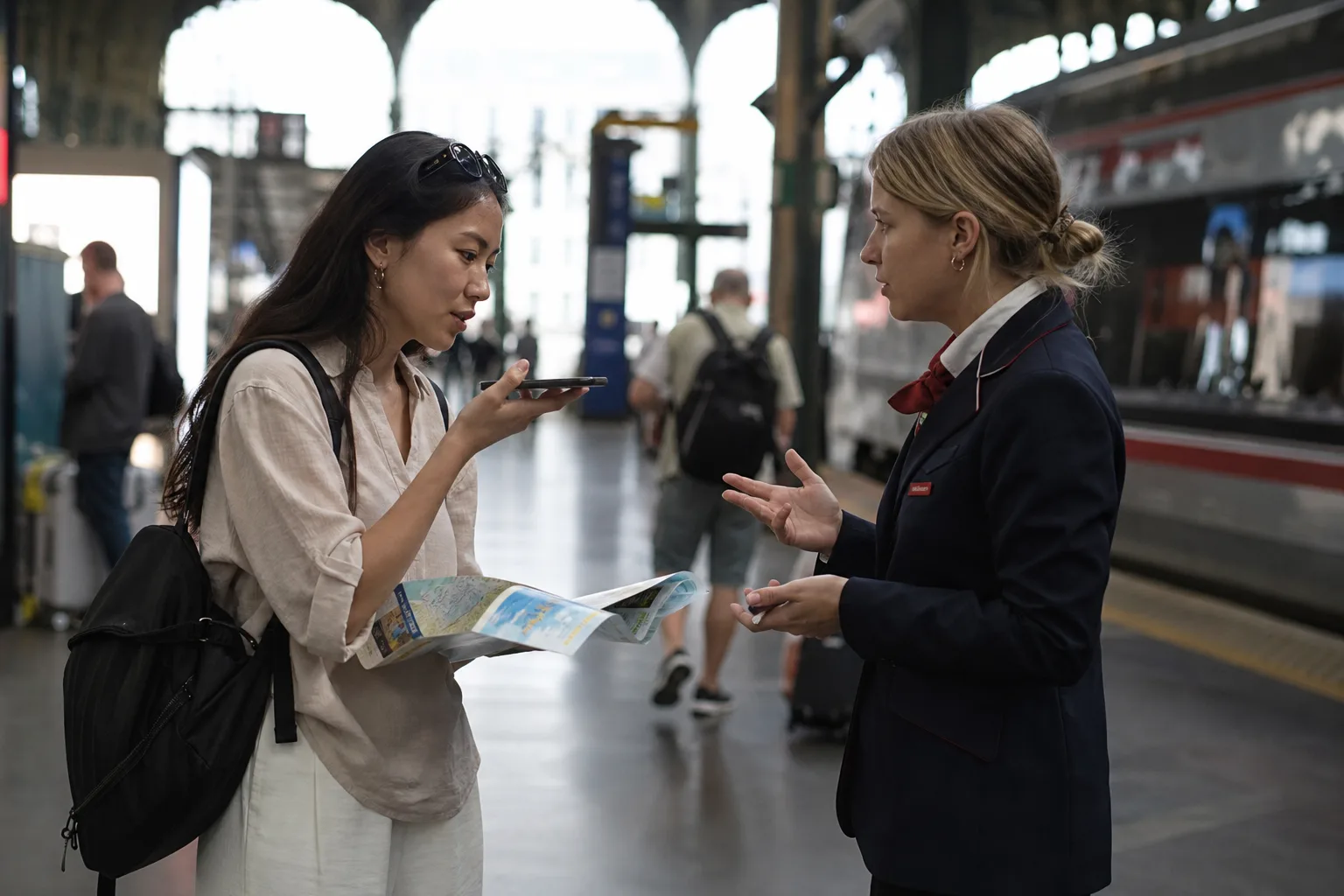
"Translation that waits for free hands doesn't work when no hands are free."
Offline capability in basements, elevators, and rural properties
Connectivity disappears at the worst moments. The mechanical room where the building's Romanian maintenance team needs to explain a boiler problem. The basement workshop where a contractor assesses water damage. The service elevator where movers confirm which floor gets which furniture. These conversations happen in signal dead zones.
The numbers confirm what expats and service providers already know: 27% of local service calls occur in low-signal environments where cloud-dependent translation tools fail mid-conversation. Old stone buildings with meter-thick walls. Rural vacation properties kilometers from the nearest cell tower. Underground parking garages during vehicle inspections.
When translation drops out mid-sentence, the dynamic shifts immediately. Workers resort to pointing and gestures. Nuanced explanations about costs, timelines, or work scope get abandoned. A plumber checking pipes under a rural Portuguese cottage cannot pause to find better signal while crouched in a crawl space. The conversation either happens offline or it doesn't happen at all.
The consequences show up later. Misunderstandings about what the quoted price includes. Confusion over which repairs were approved. Disputes that could have been avoided with a single clarifying exchange.
An offline voice translator app that works without internet removes connectivity from the equation entirely. The phone processes speech locally, the conversation continues, and both parties walk away with the same understanding. For many real service situations, offline capability is not a premium feature. It is the baseline requirement.
Privacy protection for sensitive service discussions
Service conversations often involve information that has no business sitting on third-party servers.
Step 1: Recognize what service discussions actually reveal. Coordinating with cleaners means sharing home access codes and schedules for when the house sits empty. Meeting building maintenance staff involves explaining apartment entry procedures. Arranging pet care requires handing over veterinary records and medication details. A home healthcare discussion covers medical conditions. A financial consultation touches on income and assets. Each exchange creates a data trail.
Step 2: Understand what happens to that data. The numbers tell a concerning story: 73% of free translation tools explicitly retain voice data for model training. Every sentence spoken gets transcribed, stored, and processed on cloud servers. That conversation about property damage for insurance purposes? Potentially accessible to unknown parties. The discussion about household security with a new locksmith? Logged somewhere indefinitely.
Step 3: Consider the face-to-face context. These conversations happen in homes, apartments, and private spaces. The expectation of privacy runs higher than a public tourist exchange. When someone explains a pet's chronic health condition to a veterinary assistant in São Paulo, or discusses apartment vulnerabilities with a security consultant in Warsaw, that information deserves protection.
Step 4: Match the tool to the sensitivity. A voice translator app with strong privacy protections processes speech without storing conversation audio on external servers. The translation happens, the conversation continues, and the details stay between the people in the room.
Specialized vocabularies across service sectors
Every profession speaks its own language, and tourism-focused translation tools rarely keep up.
- Veterinary appointments in Buenos Aires involve terminology for symptoms, medications, and procedures that generic translators render too literally. "Lethargy" becomes a dictionary definition rather than a clinical observation. Dosage instructions lose precision.
- Mechanic consultations in Warsaw require distinguishing between engine components, diagnostic codes, and repair options. A tourism translator might handle "brake pads" but stumble on differential fluid or timing chain tension.
- Salon appointments in Osaka use specialized terms for hair treatments, chemical processes, and styling techniques. The difference between thinning shears and texturizing scissors matters when explaining what went wrong last time.
- Courier deliveries in Nairobi involve logistics vocabulary around customs holds, delivery windows, and package handling requirements that phrasebook apps never anticipated.
The deeper challenge goes beyond vocabulary lists. When a contractor explains foundation settling, the technical description matters less than conveying whether the situation is urgent or routine. A literal translation might accurately describe soil compression while completely missing the reassuring tone that says this building is safe.
Real-time AI voice translation handles these conversations differently. The technology recognizes context, choosing appropriate terminology based on the profession and situation rather than translating each word in isolation. The result: service providers and international clients can have the same detailed, productive conversations that local customers expect.
Download Tolk on iPhone or Android and start having real conversations with local service providers wherever you live or travel.
Tolk is a Voicelabs app for face-to-face conversations. Read how Tolk works for the conversation flow, supported devices and getting started, or see what changes in Tagalog, Spanish, French, Portuguese, Japanese, Korean, Mandarin, Arabic, Thai, Vietnamese, Slovak.

Try real-time voice translation.
Start with 30 free minutes on iPhone or Android.