Hands-Free Translation for Family Dinners
January 14, 2026 · 8 min read · Published by Tolk

Family dinners with in-laws who speak another language tend to follow the same pattern. Someone says something, you grab the phone, tap the microphone, wait, tap again, read the translation, then pass it across the table. By the time everyone catches up, the moment is gone. User reviews for translation apps tell the story clearly: people want to "walk around the room while you talk to someone" without hitting buttons constantly. The technology exists. Most apps just haven't caught up with how real conversations actually flow.
The awkward choreography of button-tap translation
The scene is familiar to anyone who's married into a family that speaks another language. You're at dinner with your Thai mother-in-law, phone positioned between the rice bowls like an unwanted centerpiece. The pad thai is getting cold while everyone waits for technology to catch up.
The physical routine goes something like this:
- Pick up the phone, tap the microphone button, speak your sentence, wait for processing, tap again to play the translation
- Pass or rotate the device so your mother-in-law can respond, then repeat the entire sequence in reverse
- Watch as the conversation fragments into a series of isolated exchanges, each one requiring four to six taps minimum
- Become the "phone DJ" of the table, constantly cueing up the next translation instead of actually being present
- Miss the punchline of a joke because you were focused on finding the mic icon
Turn-based translation apps work like passing notes, not having a conversation. You speak, wait, then see results. Real conversations feel different. They're warm, with natural pauses for laughter and connection. The pauses happen because someone is thinking or savoring a moment, not because everyone is staring at a loading spinner.
By dessert, the phone has become the main character. And nobody invited it.

"The pad thai went cold three translations ago."
What dies when you tap: eye contact, gestures, and natural rhythm
The moment you look down at your phone, you lose the person in front of you. That smile, the raised eyebrow, the warmth in their expression. Gone.
- Eye contact breaks the instant your gaze drops to find the microphone button. Human connection happens in those micro-expressions, and a screen can't capture what you're not there to see.
- Gestures disappear when one hand holds the phone and your attention splits between the screen and the speaker. Touching someone's arm while you speak, pointing at something across the room, leaning in to show you care. None of it works when you're tethered to a device.
- Real conversations have overlapping energy. Cooking together, passing dishes, moving around the kitchen while catching up. Discussions on travel forums show people specifically asking for automatic translation so they can "walk around the room while you talk to someone" without hitting buttons constantly.
- The pause before each tap sends its own message. Instead of "I'm listening to you," it signals "I'm about to translate you." That split-second hesitation creates distance, turning a warm exchange into a transaction.
Body language carries half the meaning in any conversation. Tap-to-translate apps ask you to sacrifice exactly that.
The family dinner test: where tap-to-talk fails hardest
Picture a Thursday evening. A cross-cultural couple sits down for weekly dinner with the husband's Thai mother. She's eager to share news about her sister's wedding, and everyone wants this to feel like family, not a business meeting.
The conversation starts warmly enough. Then the tapping begins.
Each speaker switch demands a button press. The mother-in-law launches into her story, animated and full of details. She pauses mid-sentence, gathering her thoughts. Did she finish? Tap too early and you cut her off. Wait too long and the silence gets awkward, the moment slipping away before the app catches up.
Thai makes this harder than most languages. Tonal languages like Thai, Vietnamese, and Chinese require accuracy in tone and prosody where small mistakes don't just make you sound foreign, they make you incomprehensible. The margin for error is razor-thin. A mistranslated tone can turn a sweet memory into confusion.
The cognitive load adds up quickly. Half your attention goes to managing the app: watching for pauses, timing your taps, checking the screen. Your spouse notices. They see you staring at your phone instead of connecting with their parent. The technology meant to bring people closer is pulling you apart.
What was supposed to be a family dinner becomes a moderated panel discussion. And your mother-in-law just wants to tell you about the wedding flowers.
What truly hands-free translation looks like
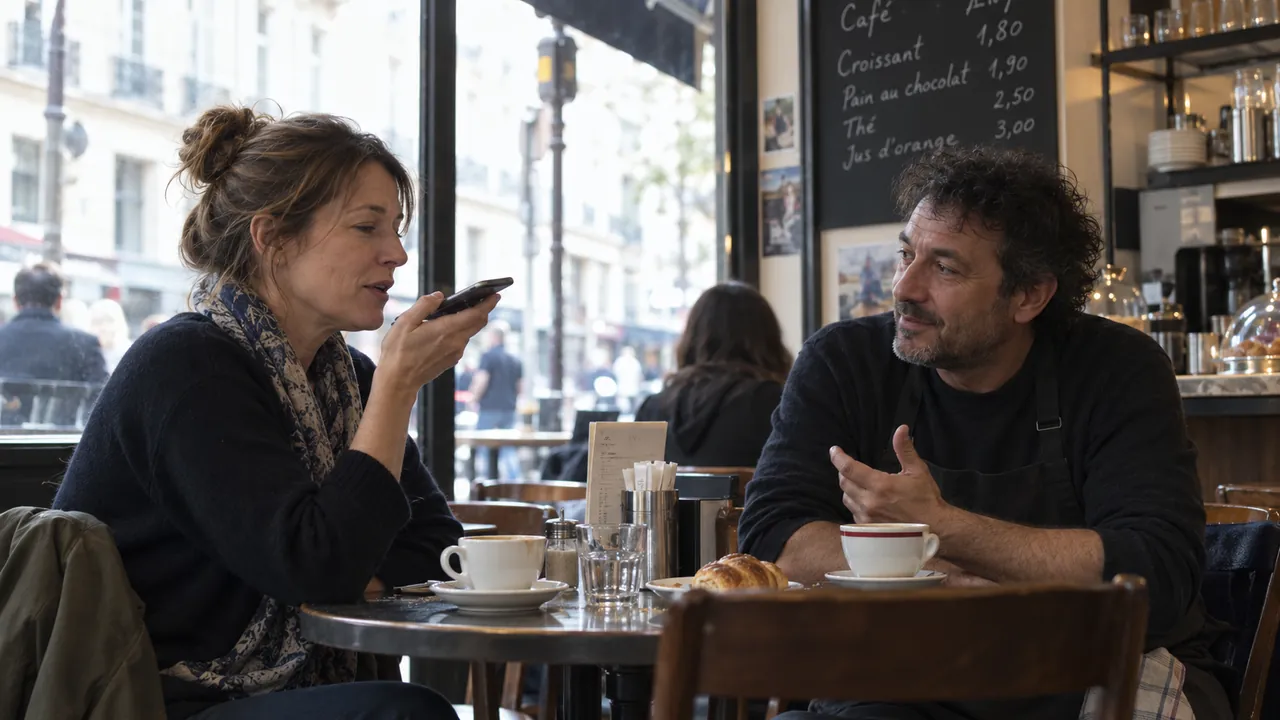
The technology exists. Hands-free translation detects when you start and stop speaking, without tapping a microphone button. No choreography required.
The difference feels immediate. The phone sits on the counter while you chop vegetables together. You gesture with both hands while explaining something. Eye contact stays where it belongs, on the person you're talking to. The translation happens in the background, almost like a quiet interpreter standing nearby.
This is what hands-free actually means. Your relationship with your mother-in-law doesn't require you to be a technical intermediary anymore. You're not the phone DJ. You're just a person having dinner with family.
Natural pauses return to their original purpose. A moment of silence means someone is thinking, savoring a memory, or searching for the right words. Not fumbling with an interface. The conversation flows like it would between two people who share a language. Understanding how real-time voice translation works helps explain why this feels so different from tap-and-wait alternatives.
There's a catch, though. The hands-free modes built into phones cover only a small set of languages. For families speaking Thai, Vietnamese, or dozens of other languages, that option often doesn't exist. The idea works. Availability is the problem.
The gap between what's possible and what's accessible remains wide.
Beyond dinner: travel moments that need your hands free
Street food stalls demand a different kind of fluency. You're pointing at unfamiliar ingredients, holding a paper bowl in one hand, fishing for cash with the other, all while asking if something contains peanuts. The vendor doesn't wait. Neither does the line behind you.
Taxi negotiations work the same way. You're gesturing toward a distant temple, showing a map on your phone, and explaining why the meter should be running. Try doing that while also tapping a microphone button between each sentence. The driver loses patience. You lose the fare.
Markets are worse. Haggling has a rhythm, a playful back-and-forth that builds momentum. Counter-offer, laugh, counter again. Pause to tap your phone and the energy deflates. The vendor moves on to someone easier.
Regional dialects and rare language pairs make these moments even harder. Strong accents like Kansai Japanese or Caribbean Spanish reduce accuracy noticeably. Uncommon combinations like Thai-Vietnamese struggle more than standard pairs like English-Spanish. Failed translations mean retries. Retries mean longer pauses. Longer pauses mean missed connections.
Then there's the offline problem. Some free translators disable voice input when you're offline, even with downloaded language packs. The workaround requires tapping through to your keyboard's native dictation. Extra steps in exactly the moments you need simplicity. Travelers looking for two-way translation that works in real conversations already know the frustration.
The best travel moments happen when your hands are full and your attention is on the person in front of you.
Translation that lets you be a family member, not a technician
The best translation apps do something counterintuitive. They disappear. The technology fades into the background, and what remains is just two people talking.
Cross-cultural couples already carry enough weight. Cultural differences, different ways of showing respect, unfamiliar holiday traditions, and the quiet pressure of wanting your partner's parents to actually know you. Adding technical friction to that mix makes everything harder.
The goal isn't perfect word-for-word accuracy. It's preserving meaning, tone, and the warmth of the moment.
When your Thai mother-in-law tells a story about your partner as a child, she's not delivering information. She's inviting you into the family. The humor matters. The affection matters. The way her voice softens on certain words, that matters too. A translation tool that captures only the dictionary meaning misses the entire point.
Real-time, hands-free translation changes the dynamic completely. Your warmth comes through. Your jokes land. Your mother-in-law responds to you, not to a sanitized version of you filtered through button taps and loading screens.
The families who feel closest aren't the ones with the most accurate translations. They're the ones where the technology stays out of the way. Where dinner feels like dinner, not a language lab.
Tolk was built for exactly this. Two people, one conversation, no switchboard between them.
Try Tolk free and have your first real conversation with your in-laws, no button tapping required.
Tolk is a Voicelabs app for face-to-face conversations. Read how Tolk works for the conversation flow, supported devices and getting started, or see what changes in Tagalog, Spanish, French, Portuguese, Japanese, Korean, Mandarin, Arabic, Thai, Vietnamese, Slovak.

Try real-time voice translation.
Start with 30 free minutes on iPhone or Android.