Talking with Locals in Thailand Without Speaking Thai
April 16, 2026 · 8 min read · Published by Tolk
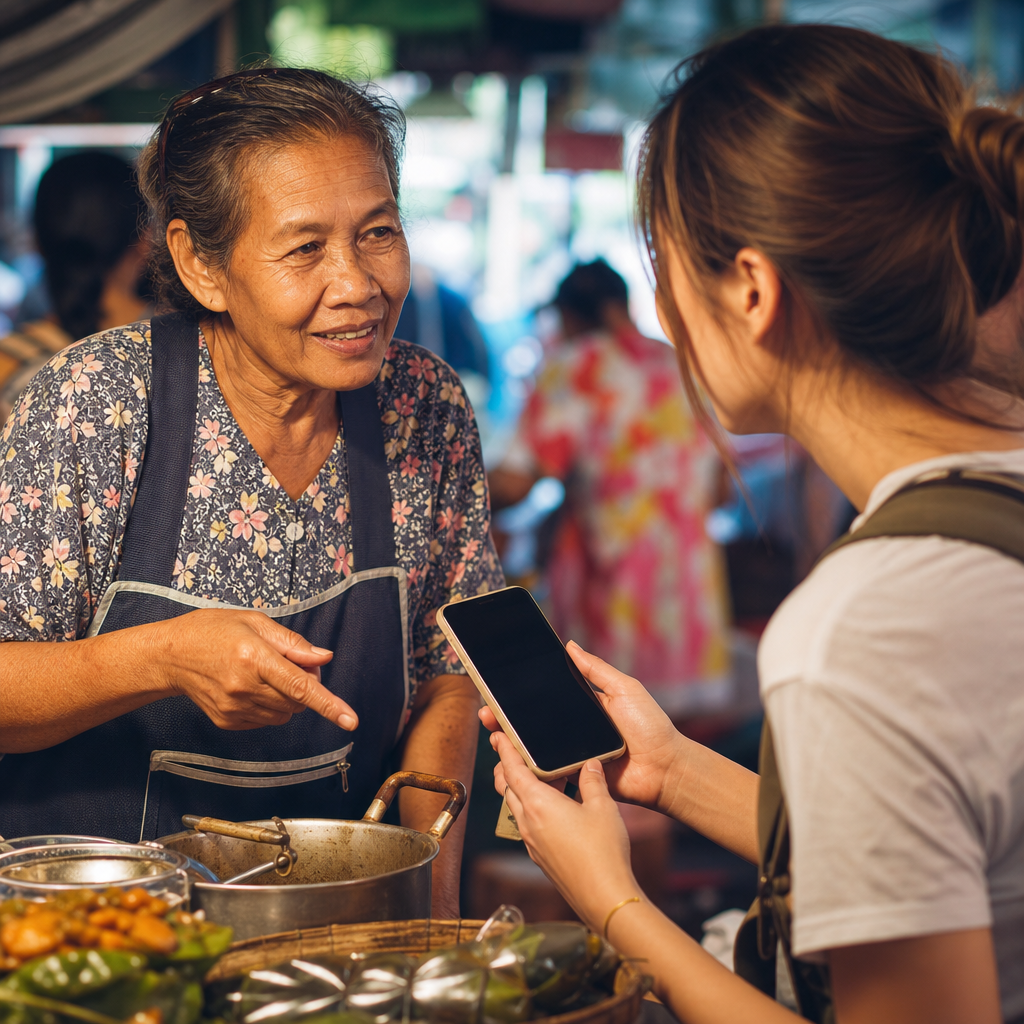
You're standing in a Bangkok pharmacy, trying to explain a stomach issue to someone who doesn't speak English. Your translation app gives you a literal translation. The pharmacist looks confused. Turns out, the phrase you needed wasn't in any phrasebook, and your app just translated words instead of meaning. We've collected five real situations where translation tech failed travelers in Thailand, plus the hybrid approach that actually got results.
Why Thailand breaks most translation apps
There's a gap between "speaking Thai" and actually communicating in Thailand. Most apps translate words, but Thai communication runs on tone, politeness particles, and context that literal translation simply misses.
- Thai has five tones where one syllable means five different things. The word "ma" can mean come, dog, or horse depending on how you say it. Apps that only show text leave you guessing, and guessing wrong gets you strange looks.
- Tech companies claim 70+ language support, yet forums tell a different story. On Reddit threads where travelers ask what actually works for communicating with Thai speakers, the consensus is clear: free text translators help, but they struggle with regional variations like Isaan dialect.
- Politeness particles change everything. Adding "khrap" or "ka" at the end of sentences signals respect. Skip them and you sound rude. Most translation apps inconsistently handle these particles, or ignore them entirely.
- Regional Thai breaks the system completely. Northern Thailand, Isaan, and Southern Thailand each have distinct dialects. Most translation apps default to Central Thai, which leaves gaps in real conversations outside Bangkok.
The five situations below follow a simple pattern: what travelers expected to work versus what actually got results.
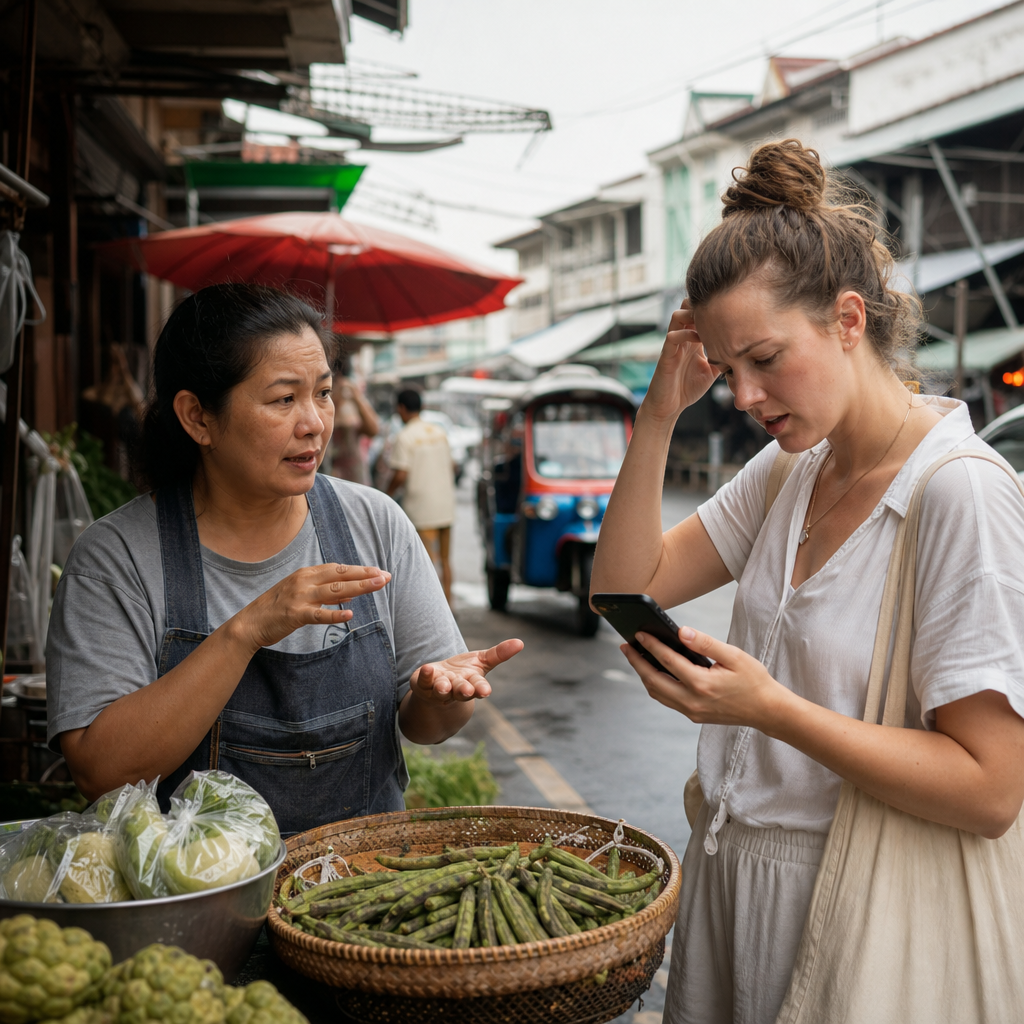
Street food ordering: When literal translation creates awkward moments
The plan seemed simple enough: type "not spicy please" into a translation app, show the screen to the vendor, get a mild pad thai. The reality played out differently.
The literal translation came across as demanding rather than polite. And "not spicy" by Thai standards still meant tears streaming down my face. Thai vendors calibrate spice levels for Thai palates, not Western ones.
The phrase "mai phet" without the softening particle "khrap" or "kha" sounds rude to Thai ears. No text translator adds these automatically.
This is the Thai politeness problem. The words are technically correct, but the meaning lands wrong. It's the difference between "No spice" and "Could I possibly have it mild, please?" One gets a nod, the other gets a look.
What actually worked: memorizing "mai phet khrap" (for men) or "mai phet kha" (for women), then using voice translation that captured a hesitant, requesting tone. The flat command that text produces misses the social context entirely.
There's another layer too. Street food vendors often use regional terms for dishes that differ from Bangkok Thai. A noodle dish in Chiang Mai might have a completely different name than its Central Thai equivalent. Translation apps default to standard Thai, which creates confusion when the vendor uses local terminology.
Context-aware translation helps here. Voice captures the back-and-forth clarification that text simply cannot.
Taxi directions: Where tones make or break your ride
The plan seemed foolproof: show the driver a Google Maps pin, maybe type the address into a translator app. Bangkok taxi rides should be straightforward with this much technology available.
- Tones turned correct syllables into gibberish. Attempting to pronounce a street name with wrong tones meant the driver had no idea what I was saying. The syllables were right, the meaning was completely lost. Thai has five tones, and getting even one wrong changes the word entirely.
- Voice translation created a broken telephone effect. Speaking into the app, my mangled pronunciation got picked up incorrectly, translated into something unrelated, then spoken back in Thai. The driver heard confident Thai audio saying something completely different from my intended destination.
- Text-only translation missed the social layer. Showing a screen with an address works, but adding a polite request changes the entire interaction. Drivers respond differently to commands versus requests.
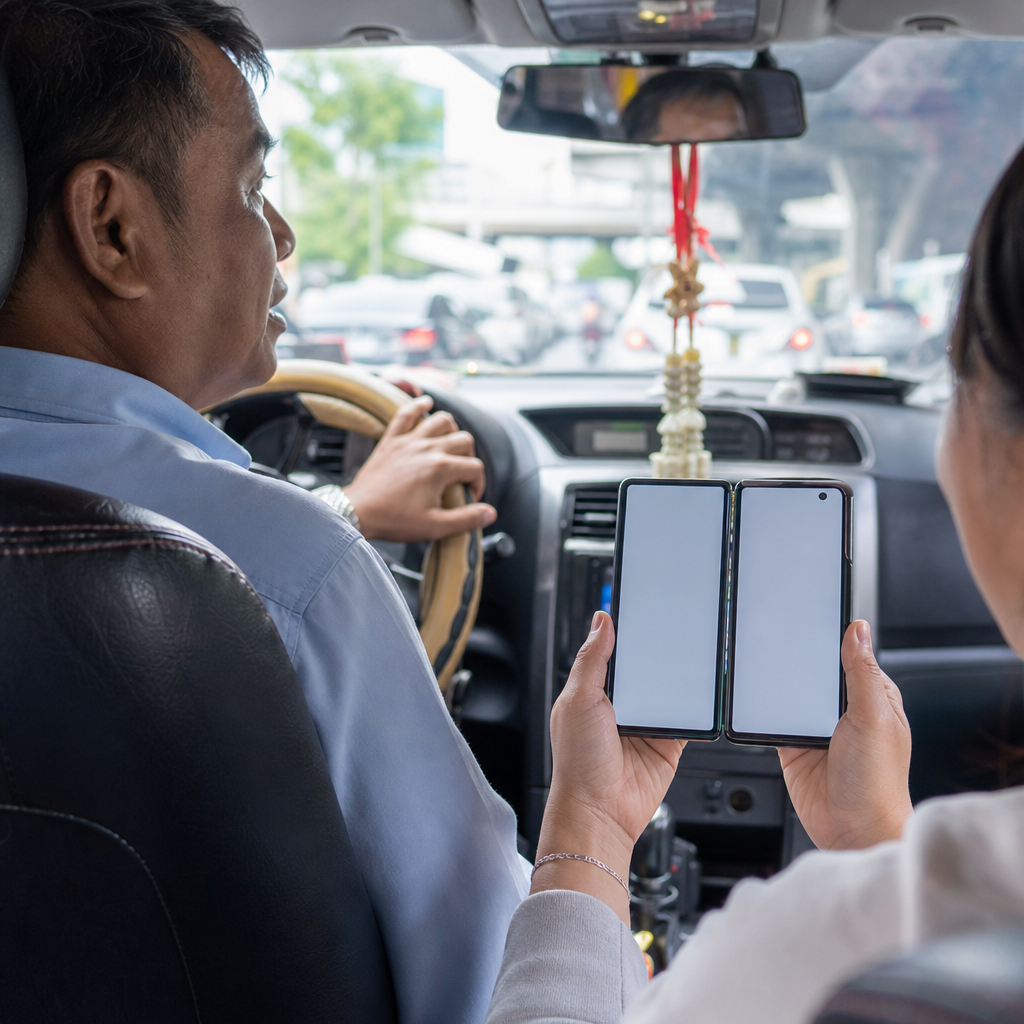
- Split-screen mode solved the communication gap. Apps that translate meaning instead of literal words let both passenger and driver see their own language simultaneously. The driver reads natural Thai text while hearing proper Thai audio, bypassing my pronunciation entirely.
Key phrase worth memorizing: "pai tee-nee khrap" (men) or "pai tee-nee kha" (women), meaning "go here please," while pointing at the map. Combines human politeness with visual clarity, and the driver fills in the gaps.
Market bargaining and hotel problems: Context changes everything
Two situations, same language, completely different rules. What works at a night market will fail at a hotel front desk, and most translation apps treat both contexts identically.
- The market approach backfired immediately. Typing "too expensive, can you lower the price?" and showing the screen produced a translation that read as confrontational. Thai market bargaining has a rhythm: smiling, showing interest, walking away, coming back. The words matter far less than the playful tone. A flat text demand skips the dance entirely.
- Thai vendors read body language alongside words. The expected exchange involves friendly back-and-forth, maybe a joke about the price being "for tourists." Literal translation misses this social layer completely. Vendors who enjoy the game will negotiate. Those who feel commanded often just wave you off.
- Hotel complaints require the opposite approach. When something is broken in your room, Thai indirect politeness can actually work against you. Being too soft means staff may not understand there's a real problem. The same English sentence needs different Thai delivery depending on context.
- Offline capability matters at markets, but accuracy drops. Some apps offer offline modes for areas without reliable wifi. Useful for night markets in smaller cities, though connected AI translation handles context better.
What worked: voice translation that recognized a polite request at the market versus a problem statement at the hotel. Same English input, different Thai output based on situational awareness.
The hardest test: Talking with Thai family members
Street food mishaps are embarrassing. Taxi confusion is frustrating. But getting it wrong with your partner's Thai family? That stays with you.
Cross-cultural couples and expats meeting Thai in-laws face communication where the stakes go beyond convenience. Politeness levels here aren't just nice, they're relationship-defining.
The plan was simple: use a free translation app for basic conversations, show respect by trying. The reality was more complicated. Formal and informal register mistakes made me sound either coldly distant with elders or inappropriately casual with senior family members. Same words, completely wrong impression.
Thai families aren't listening for perfect vocabulary. They're listening for warmth, for effort, for whether you're trying to connect or just trying to get through the conversation.
Here's what basic apps miss entirely: Thai has multiple politeness levels based on age, relationship, and social hierarchy. Speaking to your partner's grandmother requires different language than chatting with their cousin. One register for respect, another for friendliness. Most translation tools flatten everything to neutral, which reads as distant.
What actually worked: translation that carries the respectful, warm tone intended rather than dictionary-neutral output. Plus memorizing "sawadee khrap/kha" (hello, politely) and "khob khun khrap/kha" (thank you, politely) for moments when human voice matters most.
The emotional reality is straightforward. Family wants to feel connection, not transaction. Meaning and tone outweigh perfect grammar every time.
The hybrid approach: 4 Thai phrases plus the right translation tool
Four phrases are worth memorizing because apps can't replicate the human warmth they carry. "Sawadee khrap" or "sawadee kha" for hello. "Khob khun khrap" or "khob khun kha" for thank you. "Mai phet khrap" or "mai phet kha" for not spicy please. And "mai pen rai" for no problem, the phrase that smooths over any awkward moment.
These four phrases handle politeness and tone, the exact things translation apps struggle with most.
Text translation still has its place. Reading menus, decoding street signs, understanding written information where tone doesn't matter. Text works fine when nobody needs to hear you speak.
Voice translation fills a different gap. Any spoken exchange where intent, tone, and context matter, think taxis, markets, restaurants, and especially family, benefits from translation that understands what you're trying to say, not just the words you're saying. Tolk translates meaning and tone, not just words, which matters when being polite in English doesn't automatically become polite in Thai.
A reality check worth stating: no app replaces actually learning Thai for anyone staying long-term. But the right voice translation bridges the gap between phrasebook limits and real fluency. Those four phrases plus context-aware translation cover most situations travelers and expats actually encounter.
Try Tolk free and hear the difference context-aware voice translation makes for your next Thailand conversation.
Tolk is a Voicelabs app for face-to-face conversations. Read how Tolk works for the conversation flow, supported devices and getting started, or see what changes in Tagalog, Spanish, French, Portuguese, Japanese, Korean, Mandarin, Arabic, Thai, Vietnamese, Slovak.

Try real-time voice translation.
Start with 30 free minutes on iPhone or Android.